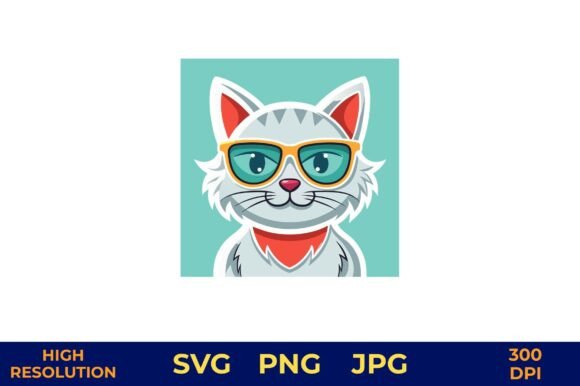
Cat Portrait with Sunglasses and Bandana
First Impressions: Bold, Playful, and Instantly Recognizable
When I opened Cat Portrait with Sunglasses and Bandana, my first thought wasn’t “cute”—it was “confident.” This isn’t a shy feline peeking from behind a curtain. It’s a laid-back, charismatic cat leaning into its own coolness—sunglasses tilted just so, red bandana knotted with casual precision, solid outline giving it graphic punch. As an embroidery designer who’s stitched hundreds of animal motifs, I immediately sensed its strength: high visual impact at medium to large sizes, clean silhouette for easy digitizing, and a personality that reads clearly even from across a craft fair booth.
A Real-World Test: Embroidering It on a Linen Tote Bag
Last week, I used Cat Portrait with Sunglasses and Bandana for a custom order—a heavyweight natural linen tote for a local pet boutique. The client wanted something fun but not juvenile, modern but handmade-feeling. I sized it to 4.5 inches wide, centered on the front panel. Because the design comes as a vector-based SVG (plus PNG/JPG with transparent backgrounds), scaling was seamless—no pixelation, no jagged edges. The 4200px base size gave me plenty of room to resize without losing definition, especially around the sunglasses’ frames and bandana folds.
Stitching went smoothly. The bold outline translated beautifully into a clean satin stitch border, while the solid interior areas worked well with dense fill stitch—no thin lines or fragile details to snag or distort. On linen, the contrast between crisp black thread and warm natural fabric made the cat pop without looking harsh. Customers stopped mid-aisle to point. That kind of reaction? That’s the sign of a design that carries weight—not just visually, but commercially.
Where It Shines (and Where to Pause)
Cat Portrait with Sunglasses and Bandana excels in projects where clarity, attitude, and scalability matter:
- Custom apparel: Works exceptionally well on sweatshirts, crewnecks, and structured tees—especially when placed on the chest or back. The strong shape holds up under garment dyeing and repeated washing.
- Tote bags & aprons: Its confident stance fills space meaningfully without overwhelming. Great for small business branding that wants to feel approachable but not childish.
- Embroidered patches: The solid outline and minimal internal detail make it ideal for iron-on or sew-on patches—clean edges mean sharp results even after multiple washes.
- Holiday & gift items: I’ve seen it stitched onto baby onesies (with soft pastel threads) and kitchen towels (in navy or charcoal)—always landing as joyful, not kitschy.
- Digital product previews: As an Illustrations asset, it’s perfect for printable mockups on Etsy listings or social media promos—its transparency and vector flexibility let you drop it cleanly onto any product photo.
But—and this is where experience matters—I’d use caution in these situations:
- Small hoop applications: Below 3 inches wide, the sunglasses’ lenses and bandana texture start to blur. Avoid for tiny cap fronts or baby hat brims unless simplified in your digitizing software.
- Stretchy or thin fabrics: While the outline is strong, the solid fill areas can pucker on lightweight knits without proper cutaway stabilizer. Always test on scrap first.
- Dark or textured backgrounds: The design relies on contrast. On heather grey fleece or heavily brushed terry cloth, subtle bandana shading may disappear. Stick to solid-color fabrics or adjust thread brightness accordingly.
- Curved surfaces like baseball caps: The horizontal bandana knot and flat facial structure don’t wrap naturally. Best placed on flat panels—front of a dad cap works; curved crown does not.
What It Adds to Your Finished Product—Beyond Stitching
This isn’t just a machine embroidery design. It’s a mood-setter. When customers see Cat Portrait with Sunglasses and Bandana on a handmade product, they read confidence, playfulness, and intentional design—not clip art. That perception lifts perceived value. A $28 embroidered pillow cover feels like a curated piece, not a craft supply leftover. For Etsy sellers, that translates directly to better conversion and fewer “Is this handmade?” questions.
It also supports brand consistency. Whether you’re selling pet-themed merch or building a line of cheeky lifestyle goods, this Graphics asset fits seamlessly—no rebranding needed. And because it’s delivered as a digital embroidery file with transparent backgrounds, it integrates cleanly into your workflow: mockup tools, design libraries, and production pipelines all recognize it as a professional-grade design asset.
Practical Designer Notes Before You Stitch
Before using Cat Portrait with Sunglasses and Bandana in your next embroidery project, here’s what I do—and recommend:
- Test on scrap fabric first—especially if using textured or stretchy material. Check how the fill stitch settles and whether the outline stays sharp.
- Review stitch density in your embroidery software. Dense fills look great on stable fabrics but can stiffen delicate ones. Adjust if needed.
- Confirm hoop size compatibility. At full scale, it’s best suited for 5x7" hoops or larger. Smaller placements require careful resizing.
- Inspect small details like sunglass reflections or bandana creases—if digitizing yourself, simplify where needed for reliability.
- Try black-and-white mockups to gauge contrast on light vs. dark garments. What reads well on white cotton may vanish on black denim.
- Use appropriate stabilizer: medium-weight cutaway for knits, tear-away for stable wovens like linen or canvas.
- Verify licensing before selling finished items or bundling the file digitally. The listing says “JUST DOWNLOAD AND PRINT YOUR OWN”—so confirm commercial use rights directly with the seller if planning resale.
In short: Cat Portrait with Sunglasses and Bandana isn’t just another cat graphic. It’s a versatile, expressive, and commercially smart embroidery file—one that earns its place in your active design library, not just your “maybe someday” folder. Use it where boldness is welcome, test it where fabric or function demands care, and trust that its personality will carry through—from needle to finished product.